|
Military |
MASCOT Operating System
Developed a pre-emptive multi-tasking real-time operating system kernel, based on MASCOT principles (Modular Approach to Software Construction, Operation and Test), in assembler for a 6809 hardware platform, used in small to medium sized control systems. Incorporated drivers for the AMD9512 floating point processor, which minimised software delays and phase shift problems during mathematically intensive control algorithm calculations.
Marine Roll Stabiliser Control System
Used MASCOT kernel to develop a roll stabiliser application in 6809 assembler. This monitored the roll motion of the ship and used a three term control law algorithm to compute demand signals for the hydraulic power units driving the aerofoil fins pro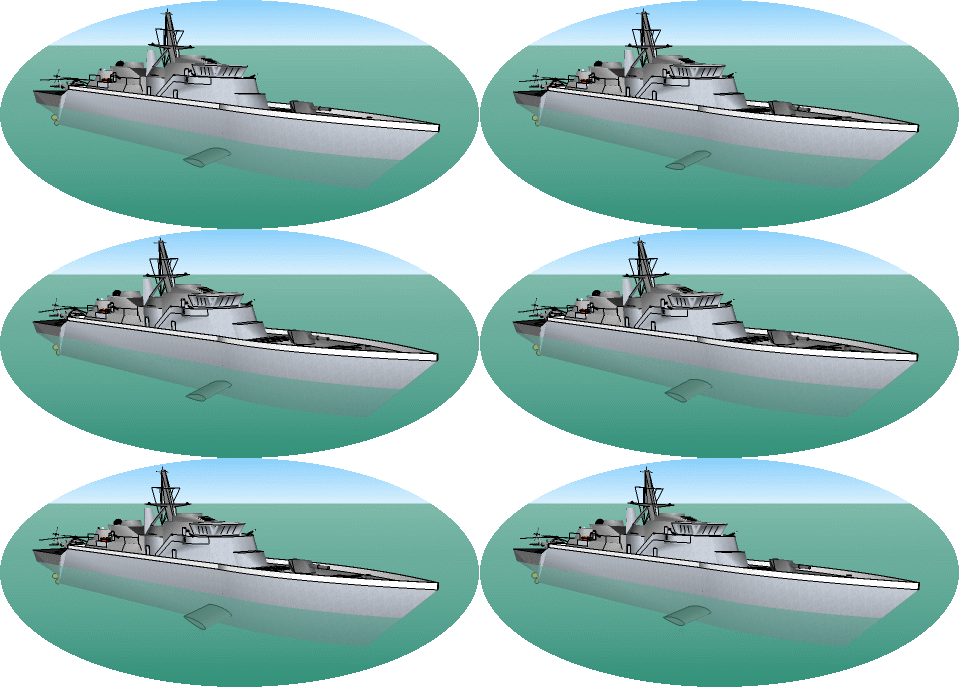 truding from the ship's hull that generate the lift forces to oppose the roll motion.
When roll angle feedback was used, roll velocity and roll acceleration were calculated from the 1st and 2nd derivatives of the roll angle signal using software based FIR (finite impulse response) digital filters. Conversely, when roll acceleration feedback was used, integration was used to calculated the roll velocity and roll angle components. The control law algorithm included a drift corrector which monitored and compensated for the natural list of the ship. Software was documented to MIL-STD JSP188 standards.
Marine Propulsion Control System
Developed software for a controllable pitch propeller propulsion control system for ships equipped with dual propellers. The speed and direction of the ship was controlled by independently varying the relative pitch of the blades on both the port and starboard propellers. Developed an engine load management algorithm which used torque feedback to continually calculate the optimum engine speed – propeller pitch relationship under a range of operating conditions. The software was documented to MIL-STD JSP188 standards.
Marine Steering Gear Control System
Developed a fail-safe multi-mode steering gear control system for patrol frigates, designed to meet Naval Standard NES 501. The rudder was driven by 3 independent hydraulic power units, which in turn were controlled by 3 separate control modes (closed loop, open loop and manual). The closed loop mode used analogue demand and feedback signals to operate proportional control hydraulic valves.
Co-author of the comprehensive Failure Mode and Effects Analysis (FMEA) report, written to MIL-STD 1629A for the steering system. The results of the combined controls and hydraulic analysis, collated using a customised database, were presented in reliability block diagram format so that the operational dependence or independence of the system's component parts could be easily identified. The core information for the detailed repair and maintenance manuals was generated simply by sorting the database by failure effect, rather than failure mode.
Aircraft CRT Display Unit
Developed hardware and software for an intelligent vector graphics Cathode Ray Tube (CRT) display unit, for use with in military aircraft cockpit installations. The hardware, designed to meet MIL-STD 883B, included an RS422 master/slave multi-drop link and high power op-amps to drive the magnetic deflection coils of the CRT. The real-time software was written in 8051 assembler and conformed to RTCA/DO-178A (EUROCAE ED-12A) standards for airborne systems.
Please send comments about this website to webmaster@atc-ltd.co.uk.
Copyright © 2025 Automatic Test & Control Limited. All rights reserved.